Showing posts with label A1. Show all posts

Tuesday, 30 November 2021

VICTORIA TO BATH AT CHRISTMAS - TORNADO STEAM RAILTOUR - TUESDAY 30th NOVEMBER 2021

Bath Christmas Markets 2021
Might be November still but there are plenty of Christmas trips being organised and markets, shopping in full swing with the festive season fast approaching, what better way to give yourself (and a loved one perhaps) an early present with a steam tour to one of England's stunning locations - Bath. 

London Victoria to Bath at Christmas(*)
Departure Date:
Tuesday 30th November 2021
(*) yes I know it's November still, and Christmas is some way off. 
Departing from, with approximate departure times:
London Victoria (d 08:45), Staines (d 09:30), Woking (d 10:10)
>> Arrival at Bath Spa due 13:05.

Travel to the stunning roman city of Bath and explore its many museums and places of interest. It has some of the very finest architectural sights in Europe including the Roman Baths and Pump Room, Pulteney Bridge, the Abbey and Royal Crescent.

BATH CHRISTMAS MARKET
We are aware that the official Bath Christmas Market will not be going ahead this year in its usual format. However, there are still plenty of ways to enjoy the festive period in one of the UK's most iconic Christmas cities. Some of the wonderful activities on offer will include a Christmas light trail taking you on a journey to some of Bath's most iconic architecture, Bath's artisan makers showcasing their crafts around Bath Abbey Quarter and Queen Square, and Luke Jerram's global phenomenon, Museum of the Moon, will be the centrepiece of Bath Abbey. 

Bath’s biggest independent market returns this Christmas! After a break of nearly two years, Bath’s biggest and favourite independent artisan market is back and running every day from the 20th November to the 19th December. Put your skates on and have go on the Ice at the Royal Victoria Park. 
The Ice Rink is back and, with 1000 square metres of smooth ice, it’s bigger than ever! Glowing in an array of atmospheric lights, it’s the ideal spot to practice those skating skills and simultaneously the perfect stage for avid skaters to show off their moves. With music to set the wintery scene, a cozy bar area and seasonal drinks you will be transported to a dreamy winter wonderland!
Or how about a round of 'Glow Golf' located next door to the Ice rink. Bath’s popular adventure golf course will be decked out with its very own fairy light installations. Playing golf at night with glow-in-the-dark balls adds a whole new layer of excitement to the classic daytime experience.

Steam Hauled by A1 Class Pacific '60163 Tornado'
60163 Tornado is the newest steam engine on the national network (at time of writing). The original Peppercorn A1 series were ordered by the LNER, but the 49 locomotives were built at Doncaster and Darlington for British Railways (BR) in 1948–49, after the nationalisation of the railways in the United Kingdom. Following the modernisation and dieselisation plans of the 1950s, the A1 Peppercorn class was eventually scrapped at a comparatively early age of just 15 years.

The original Peppercorn A1s were designed to cope with the heaviest regular post-war East Coast trains. First steamed in 2008, after a 19 year project to fund and build the locomotive, Tornado was built to be not a replica, but the 50th A1. The original 49 A1s were built for the London & North Eastern Railway (LNER) between 1948 and 1949. Sadly after the withdrawal of steam in 1968 none of the LNER A1 class engines were saved from the scrapper's torch. In 1990 a group of enthusiasts founded a trust (A1 Steam Locomotive Trust) to return this missing link.

Tornado moved under its own power for the first time on 29th July 2008 at Darlington, and then spent two months at the Great Central Railway in Loughborough, where it was tested up to 60 mph (97 km/h) and operated its first passenger train. Tornado then moved to the National Railway Museum (NRM) in York for three test runs on the main line up to 75 mph (121 km/h). After repainting from works grey into LNER Apple Green, Tornado was approved for mainline passenger operation. On 31st January 2009 Tornado hauled its first passenger trip on the main line, The Peppercorn Pioneer, from York to Newcastle and back. By hauling various A1 Trust railtours, charters and other activities, Tornado will begin to recoup the estimated £800,000 debt from the project, which cost around £3 million.

Tornado has 3 cylinders, 6 driving wheels and a firebox of 50sq.ft. Tornado is a regular locomotive for Steam Dreams, often seen on trips along the East Coast Mainline to York. Whilst limited to 75 mph today, A1s are capable of achieving speeds in excess of 100mph. During its short life Tornado has twice hauled the Royal Train.

Thursday, 12 August 2021

THE ABERDONIAN STEAM RAILTOUR [A1 No 60163 Tornado] - Thursday 12th August

A1 Class Tornado

The Aberdonian Steam Railtour (A1 Steam Locomotive Trust)
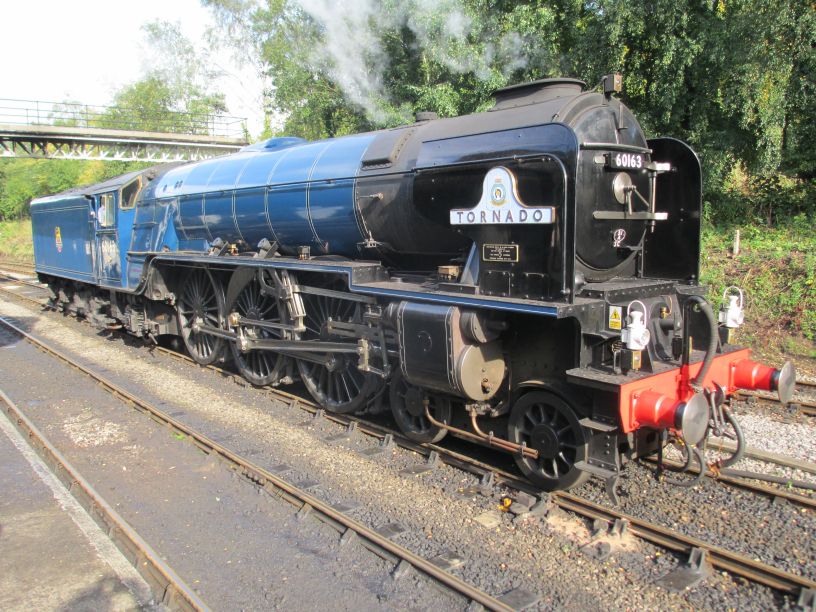
Steam hauled by Class A1 No 60163 Tornado (Pictured above)

60163 Depart; Edinburgh Waverley @09:39(pu) - Forth Bridge - Kirkcaldy - Perth - Dundee - Montrose - Aberdeen.

Let the ‘The Aberdonian’ whisk you away as we take in some of the best that Scotland has to offer, both on train and off. Crossing the Forth Bridge, the train runs along the coast for much of its route making it an unrivalled way to experience Scotland. In Aberdeen there is a chance to explore this historic city, or take one of our off train excursions that include a castle or distillery visit. On board the train you can sit back in comfortable seats and large windows through which to admire the scenery. Our friendly team will look after you, and if you choose to dine with us you will be treated to fine Scottish fare. Come and travel with us as Tornado runs regularly over this historic route.

Forth Bridge

Our journey begins in Scotland’s capital and its imposing Waverley station, right in the heart of the city, in the shadow of the Castle. Tornado steams through Princes Street Gardens and pauses to pick up further passengers at Haymarket station in the west of the city. From there we leave the city surroundings and pass open countryside before our train will start to slow. The Forth Bridge is one of the wonders of the modern world, and a UNESCO World Heritage Site, crossing over 350ft above the water and stretching over one and a half miles in length. First opened in 1890, Tornado will lead our train across this magnificent structure giving amazing views of the Firth of Forth and we cross into the Kingdom of Fife. The railway follows the coast line through Inverkeithing and Burntisland where the city of Edinburgh can be seen across the Forth. Approaching Kirkcaldy the route turns north whilst remaining alongside the coast, but once we leave the town behind we move into the rich countryside of Fife with its farming communities and many golf courses.

Tornado decked out in BR Blue
The route is then via Perth and follow the route of the River Tay to Dundee.  Our departure from Dundee is through tunnels under the city, and we exit the city and head alongside the River Tay out as far as the world-famous golf course of Carnoustie. We then continue alongside the river as we make our way eastwards passing the coastal town of Arbroath, famous for its Smokie’s which are still produced in the town. Our route takes switches from running along the coast to diving inland and back again before crossing the Montrose Basin with the railway sandwiched between the water and Montrose itself. As we leave Montrose behind we are running through the stunning Scottish countryside as we leave the coast behind for a while. Passing through Laurencekirk and Fordoun and Drumlithie it is a chance to see the lush and unspoiled country for which Scotland is rightly proud.

The service will depart from Edinburgh Waverley  9:39am and the return will get you back into the capital late evening so a long day of touring and plenty of value for money around some of the best scenery on offer.

Steam Hauled by A1 Class Pacific '60163 Tornado'
The original Peppercorn A1 series were ordered by the LNER, but the 49 locomotives were built at Doncaster and Darlington for British Railways (BR) in 1948–49, after the nationalisation of the railways in the United Kingdom. Following the modernisation and dieselisation plans of the 1950s, the A1 Peppercorn class was eventually scrapped at a comparatively early age of just 15 years.

The original Peppercorn A1s were designed to cope with the heaviest regular post-war East Coast trains. The A1 Trust intended Tornado to be built from scratch, designed and built as the next locomotive in the A1 Peppercorn class, not as a replica or restoration project, but an evolution of the class incorporating design improvements that would have occurred had steam motive power continued on the mainline railway.
  
Tornado moved under its own power for the first time on 29th July 2008 at Darlington, and then spent two months at the Great Central Railway in Loughborough, where it was tested up to 60 mph (97 km/h) and operated its first passenger train. Tornado then moved to the National Railway Museum (NRM) in York for three test runs on the main line up to 75 mph (121 km/h). After repainting from works grey into LNER Apple Green, Tornado was approved for mainline passenger operation. On 31st January 2009 Tornado hauled its first passenger trip on the main line, The Peppercorn Pioneer, from York to Newcastle and back. By hauling various A1 Trust railtours, charters and other activities, Tornado will begin to recoup the estimated £800,000 debt from the project, which cost around £3 million.

Thursday, 15 July 2021

THE CHESHIREMAN - London Euston to Chester A1 Class 60163 Tornado

The Cheshireman
  - Thursday 15th July 2021

A1 Class Tornado 60163
Steam Hauled realtor, London (Euston) to Chester with A1 Class locomotive 60163 Tornado.
Route
London Euston (pu) - Watford Junction (by service train to Milton Keynes) (pu) - Milton Keynes Central (pu) - Northampton (pu) - Rugby (pu) - Nuneaton (pu) - Stafford - Crewe - Chester and return.

This tour offers a wonderful opportunity to travel by a special charter train to the historic city of Chester. The train will be steam-hauled throughout from London Euston to Chester by A1 Class locomotive No. 60163 Tornado. We will follow the route of the famous express such as the Royal Scot along the west coast main line (WCML) to Crewe and then onwards to Chester. We can expect some spirited running down the WCML to Crewe. Be sure to book early to join us on this historic occasion.

‘The Cheshireman’ will leave London Euston at around 07:00 steam hauled behind Tornado. Initially on departure we shall hear our locomotive working hard on the climb up Camden Bank. We continue through Watford Tunnel into rural Hertfordshire. We stop to pick up further passengers at the 1960s ‘new town’ of Milton Keynes, where passengers from Watford Junction will join by service train. At Hanslope Junction, we leave the West Coast Main Line (WCML) and take the Northampton loop line where we stop again for passengers.

We continue northwards and pass the Daventry Railfreight Terminal (DIRFT) before re-joining the WCML at Rugby, a further pick up stop, and the birthplace of rugby football and the jet engine. We then follow the Trent Valley Line to Nuneaton, our final stop to pick up passengers. We pass through Lichfield, notable for its three-spired medieval cathedral, and soon after Rugeley is Shugborough Tunnel. This has ornamental grand entrances, the result of conditions required by the Earl of Lichfield for building the line across his estate. We continue northwards through Stafford to the famous railway junction town of Crewe where we take the North Wales Coast Line to Chester.

Tornado in BR Blue livery
There will be around four hours to explore the Roman city of Chester, one of the most visited places in the UK. Chester lies on the river Dee, close to the border with Wales, and is one of the best preserved walled cities in Britain. The city contains a number of medieval buildings and is famous for its 14th Century ‘Rows’, the first floor level galleried walkways connecting shops and cafes. Other places of interest include the Castle, the Cathedral, and the picturesque racecourse, which is located between the city walls and the river Dee.

Our special train, hauled on the return journey by our steam locomotive Tornado, leaves Chester late afternoon for the return journey to London Euston. We stop at the same stations as on the outward journey to set down passengers, and this tour promises to be one of excitement as Tornado is allowed to reach its maximum permitted speed along the WCML.

Steam Hauled by A1 Class Pacific '60163 Tornado'
The original Peppercorn A1 series were ordered by the LNER, but the 49 locomotives were built at Doncaster and Darlington for British Railways (BR) in 1948–49, after the nationalisation of the railways in the United Kingdom. Following the modernisation and dieselisation plans of the 1950s, the A1 Peppercorn class was eventually scrapped at a comparatively early age of just 15 years.

The original Peppercorn A1s were designed to cope with the heaviest regular post-war East Coast trains. The A1 Trust intended Tornado to be built from scratch, designed and built as the next locomotive in the A1 Peppercorn class, not as a replica or restoration project, but an evolution of the class incorporating design improvements that would have occurred had steam motive power continued on the mainline railway.
  
Tornado moved under its own power for the first time on 29th July 2008 at Darlington, and then spent two months at the Great Central Railway in Loughborough, where it was tested up to 60 mph (97 km/h) and operated its first passenger train. Tornado then moved to the National Railway Museum (NRM) in York for three test runs on the main line up to 75 mph (121 km/h). After repainting from works grey into LNER Apple Green, Tornado was approved for mainline passenger operation. On 31st January 2009 Tornado hauled its first passenger trip on the main line, The Peppercorn Pioneer, from York to Newcastle and back. By hauling various A1 Trust railtours, charters and other activities, Tornado will begin to recoup the estimated £800,000 debt from the project, which cost around £3 million.

Friday, 21 May 2021

STEAM TOURS - THE SOUTH DEVON EXPLORER - TORNADO 60163

THE SOUTH DEVON EXPLORER - TORNADO 60163
The South Devon Explorer
Saturday 29th May 2021
The South Devon Explorer offers an exceptional day out travelling by train from stations in Berkshire to Plymouth in South Devon. We travel along the famous ‘sea wall’ from Dawlish to Teignmouth and over the South Devon banks through Totnes. The special train will be hauled from Bristol to Plymouth and back by steam locomotive No. 60163 Tornado.

Our train starts from Woking in Surrey and will be diesel hauled from there to Bristol. There are additional stops at Guildford, Reading and Newbury to pick up more passengers. The route follows the river Kennet through attractive countryside and then runs beside the Kennet and Avon Canal for some distance before we make our final stop for passengers at Westbury. Once the tour has reached Bristol we will be able to make the change of motive power where steam locomotive No. 60163 Tornado will take over the train.

We shall soon be speeding along through the Somerset countryside and across the Somerset Levels to Taunton, where we make a brief stop for our steam locomotive to take on water. Our steam locomotive will be working hard as we climb to Whiteball Summit on the Somerset and Devon border before descending through the Culm Valley to Exeter.
The route will follow the Exe Estuary, passing the picturesque Cockwood Harbour, and run along the famous sea wall from Dawlish to Teignmouth. This is one of the most famous and scenic stretches of railway line in Britain, which gained international prominence when part of it was washed away in the 2014 storms. After Newton Abbot, we follow the South Devon line to Plymouth. Immediately we start to climb the very steep gradient of Dainton Bank. The climb twists and turns all the way to the summit at Dainton Tunnel.

A short reprieve for our fireman follows as we descend the gradient to Totnes, which will allow time to get the boiler pressure up for the next climb of Rattery Bank. Gradients as steep as 1 in 47 run for four miles to Rattery before they ease off for the remainder of the climb to the summit at Wrangaton. Running along the southern edge of Dartmoor, we descend towards Plymouth, our destination for the afternoon. There will be time here to visit this modern city, with its many attractions, including the Hoe with Smeaton’s Tower, the old Barbican area with the Mayflower Steps, and the many shops in the city centre. The return journey as far as Taunton will be steam hauled by Tornado. The first real challenge faced will be the ascent of the 1 in 42 gradient of Hemerdon Bank just outside Plymouth. There is also the climb to Dainton Tunnel from Totnes, followed by the return run along the Dawlish sea wall to Exeter. From Taunton, the train will be diesel hauled back to Woking. We stop at the same stations as on the outward journey, to set down passengers.

Steam Hauled by A1 Class Pacific '60163 Tornado'
The original Peppercorn A1 series were ordered by the LNER, but the 49 locomotives were built at Doncaster and Darlington for British Railways (BR) in 1948–49, after the nationalisation of the railways in the United Kingdom. Following the modernisation and dieselisation plans of the 1950s, the A1 Peppercorn class was eventually scrapped at a comparatively early age of just 15 years.

The original Peppercorn A1s were designed to cope with the heaviest regular post-war East Coast trains. The A1 Trust intended Tornado to be built from scratch, designed and built as the next locomotive in the A1 Peppercorn class, not as a replica or restoration project, but an evolution of the class incorporating design improvements that would have occurred had steam motive power continued on the mainline railway.
  
Tornado moved under its own power for the first time on 29th July 2008 at Darlington, and then spent two months at the Great Central Railway in Loughborough, where it was tested up to 60 mph (97 km/h) and operated its first passenger train. Tornado then moved to the National Railway Museum (NRM) in York for three test runs on the main line up to 75 mph (121 km/h). After repainting from works grey into LNER Apple Green, Tornado was approved for mainline passenger operation. On 31st January 2009 Tornado hauled its first passenger trip on the main line, The Peppercorn Pioneer, from York to Newcastle and back. By hauling various A1 Trust railtours, charters and other activities, Tornado will begin to recoup the estimated £800,000 debt from the project, which cost around £3 million.

Saturday, 3 October 2020

RETIMED RAILTOUR - THE EASTERLING - STEAM HAULED TORNADO 60163

THE EASTERLING - STEAM HAULED TORNADO 60163

The Easterling
Saturday 3rd October 2020
Join us on a journey by steam train to rural Norfolk and Suffolk, a scenic area of undulating farmland, market towns, picturesque villages and waterways.
The Easterling recalls the days of an express train that ran from London to Yarmouth and Lowestoft, taking Londoners to the Norfolk Broads and the famous East Anglian seaside resorts. The train will be hauled by A1 Class Pacific 60163 Tornado.

Our steam train will depart from London King’s Cross station at around 08:00 and immediately begins climbing through tunnels and cuttings as it makes its way up the East Coast Main Line (ECML). There are stops at Potters Bar and Stevenage for more passengers to join the train. At Hitchin, we leave the ECML and head for Cambridge, our final stop for passengers. We continue north to Ely and then take the Breckland Line through Thetford to Norwich. The Breckland area is of considerable interest for its unusual flora and fauna, and is characterised by gorse-covered sandy heath land and Scots Pine trees.

We arrive at Norwich around mid-day and our steam locomotive ‘runs round’ our train as we change direction of travel here. We continue our steam hauled journey taking one of the ‘Wherry Lines’ from Norwich to Lowestoft. The Norfolk Wherry is a type of boat that was widely used in the area. Lowestoft is the most easterly town in the UK and terminus for the East Suffolk Line (ESL). Our train stops here for well over an hour giving passengers time to explore the town and harbour, once a bustling fishing port.

Our return journey is along the 49 mile-long scenic ESL through Beccles, Saxmundham and Woodbridge, famous for having the only working Tide Mill in the UK, dating from 1793. Westerfield Junction is where the branch line from Felixstowe joins the ESL; the branch is heavily used by freight trains to and from Felixstowe Docks. Approaching Ipswich, we take the newly built ‘Bacon Factory Chord’ to join the Great Eastern Main Line (GEML) going northwards from London Liverpool Street to Norwich.

We continue northwards to Stowmarket and leave the GEML at Haughley Junction. We pass through Bury St. Edmunds station, with its distinctive pair of towers. At Snailwell Junction we take the line for Newmarket and Cambridge, where we stop to set down passengers. We make further stops to set down passengers at Stevenage and Potters Bar before journeys end at London King’s Cross.


Steam Hauled by A1 Class Pacific '60163 Tornado'
The original Peppercorn A1 series were ordered by the LNER, but the 49 locomotives were built at Doncaster and Darlington for British Railways (BR) in 1948–49, after the nationalisation of the railways in the United Kingdom. Following the modernisation and dieselisation plans of the 1950s, the A1 Peppercorn class was eventually scrapped at a comparatively early age of just 15 years.
The Easterling Steam Hauled by Tornado A1 60163
Other famous East Coast Main Line steam locomotives have been preserved, for example, six Gresley LNER Class A4s, one LNER Class A3, 4472 Flying Scotsman, and one LNER A2 60532 Blue Peter but all 49 LNER Peppercorn Class A1 locomotives were scrapped. The last was 60145 St Mungo, which survived until September 1966. An effort was made to preserve 60145, but it failed due to a lack of proper funds. The original Peppercorn A1s were designed to cope with the heaviest regular post-war East Coast trains. The A1 Trust intended Tornado to be built from scratch, designed and built as the next locomotive in the A1 Peppercorn class, not as a replica or restoration project, but an evolution of the class incorporating design improvements that would have occurred had steam motive power continued on the mainline railway.
  
Tornado moved under its own power for the first time on 29th July 2008 at Darlington, and then spent two months at the Great Central Railway in Loughborough, where it was tested up to 60 mph (97 km/h) and operated its first passenger train. Tornado then moved to the National Railway Museum (NRM) in York for three test runs on the main line up to 75 mph (121 km/h). After repainting from works grey into LNER Apple Green, Tornado was approved for mainline passenger operation. On 31st January 2009 Tornado hauled its first passenger trip on the main line, The Peppercorn Pioneer, from York to Newcastle and back. By hauling various A1 Trust railtours, charters and other activities, Tornado will begin to recoup the estimated £800,000 debt from the project, which cost around £3 million.

Saturday, 1 June 2019

FLYING SCOTSMAN LONDON TO SALISBURY AND HAMPSHIRE TOUR 1st JUNE 2019


London to Salisbury with Flying Scotsman. 
This rail tour in two parts will depart from London Victoria on Saturday 1st June 2019, scheduled timing from London is 08:45 for this journey through the southern rails network and taking us in the famous town of Salisbury before a tour of Hampshire later. Arrival time into Salisbury is scheduled for 11:36. The return journey back to London is expected to depart around 18:24 with an arrival in London Victoria for 21:31. 
Salisbury was recently in the news for the Russian spy and poison scandal but there's plenty to enjoy here not only the home of the tallest Cathedral spire in England and known as "The city in the countryside", the magnificent medieval city of Salisbury has it all, historic streets and alleyways alongside a range of attractions. If you are not on the additional Countryside Tour then you have about five hours to enjoy Salisbury and have a spot of lunch before coming home. So what better way to arrive in style than behind one of the most famous and iconic steam locomotives in the world. 

HAMPSHIRE COUNTRYSIDE TOUR
While Flying Scotsman waits in Salisbury there is an additional tour which can be booked around the Hampshire countryside. Scotsman will depart about 3pm and spin you around a wonderful summertime journey through Hampshire's countryside towards the coast. Should arrive back into Salisbury by 5:23pm ready for the return run to London.
Flying Scotsman info;
60103 Flying Scotsman has been described as the most famous steam locomotive in the world. Built in 1923 for the London and North Eastern Railway (LNER) at Doncaster Works to a design of H.N. Gresley, it was employed on long-distance express trains on the LNER and its successors, British Railways Eastern and North-Eastern Regions, notably on the London to Edinburgh Flying Scotsman train service after which it was named.

The locomotive set two world records for steam traction, becoming the first steam locomotive to be officially authenticated at reaching 100 miles per hour on 30 November 1934, and then setting a record for the longest non-stop run by a steam locomotive when it ran 422 miles on 8 August 1989 while in Australia. 

Retired from regular service in 1963 after covering 2,076,000 miles, Flying Scotsman gained considerable fame in preservation under the ownership of Alan Pegler, William McAlpine (seen below), Tony Marchington and finally the National Railway Museum (NRM). As well as hauling enthusiast specials in the United Kingdom, the locomotive toured extensively in the United States and Canada (from 1969 to 1973) and Australia (from 1988 to 1989).
Flying Scotsman Tours


Thursday, 14 March 2019

UK RAILTOUR -- THE ABERDONIAN – 14th MARCH 2019

THE FORTH RAIL BRIDGE
Thursday 14th March
THE ABERDONIAN RAILTOUR
Featuring A1 Class - 60163 "TORNADO" 

Here's a fantastic tour with views to savour behind the A1 Tornado. Crossing both the Forth Bridge and the Tay Bridge, the train runs along the coast for much of its route making it an unrivalled way to experience Scotland. In Aberdeen there is a chance to explore this historic city, or take one of our off train excursions that include a castle or distillery visit. On board the train you can sit back in comfortable seats with large windows through which to admire the scenery. Our friendly team will look after you, and if you choose to dine with us you will be treated to fine Scottish fare. Come and be one of the first to travel with us as Tornado begins another chapter running regularly over this historic route.

THE JOURNEY
Our journey begins in Scotland’s capital and its imposing Waverley station, right in the heart of the city, in the shadow of the Castle. Tornado steams through Princes Street Gardens and pauses to pick up further passengers at Haymarket station in the west of the city. From there we leave the city surroundings and pass open countryside before our train will start to slow.


The Forth Bridge (page top) is one of the wonders of the modern world, and a UNESCO World Heritage Site, crossing over 350ft above the water and stretching over one and a half miles in length. First opened in 1890, Tornado will lead our train across this magnificent structure giving amazing views of the Firth of Forth and we cross into the Kingdom of Fife. The railway follows the coast line through Inverkeithing and Burntisland where the city of Edinburgh can be seen across the Forth. Approaching Kirkcaldy the route turns north whilst remaining alongside the coast, but once we leave the town behind we move into the rich countryside of Fife with its farming communities and many golf courses. We cross the beautiful countryside before pausing at Leuchars station where Tornado takes on water.
THE ABERDONIAN RAILTOUR SCOTLAND

Once underway again it is not long before the train slows as we approach the River Tay and its long elegant bridge across to Dundee. The Tay Bridge (above) is two miles in length, with 85 spans, and links Fife to the City of Dundee and the County of Angus. This is the second Tay Bridge, opening in 1887, after the first was destroyed in a storm in 1879.

Our departure from Dundee is through tunnels under the city, and we exit the city and head alongside the River Tay out as far as the world-famous golf course of Carnoustie. We make our way eastwards passing the coastal town of Arbroath, famous for its Smokie’s which are still produced in the town. Our route takes switches from running along the coast to diving inland and back again before crossing the Montrose Basin with the railway sandwiched between the water and Montrose itself. As we leave Montrose behind we are running through the stunning Scottish countryside as we leave the coast behind for a while. Passing through Laurencekirk and Fordoun and Drumlithie it is a chance to see the lush and unspoilt country for which Scotland is rightly proud.


Bittern using the refurbished turntable at Ferryhill Depot.
As our journey progresses we pass Stonehaven and then exit the town on the cliffs above the North Sea. We run high above the water below all the way to Aberdeen now on what is a wonderful finish to a unique railway journey. Tornado will run at speed alongside the water and on the approach to our destination we will slow and take a winding course through the Granite City before crossing the River Dee on a beautiful curving bridge. Once across the river on our left is the recently refurbished turntable at the former Ferryhill depot (above left). This is where Tornado will be turned for our return journey and is something that is important facility to make this magnificent journey possible. We continue on a little further and we then arrive into Aberdeen’s light and airy station ready for onwards excursions.

EXPLORING ABERDEEN
There is plenty to see and do in the centre of the bustling city of Aberdeen, and a lot of attractions are within easy walking distance of the station. For those attractions a little further out, there are local taxis and regular bus services: a hopper ticket to explore the city by bus costs less than £5.

Whisky Tasting –  CASC are avatars of hedonism, demanding excellence and rejecting anything less. CASC (Cigars, Ale, Scotch & Coffee) – are relentless in the pursuit of great products and overwhelming choice. Doing things their way and never compromising. Focussing on quality cigars, craft beer, scotch whisky and artisan coffee, they aim to compound the senses and deliver a truly unique bar experience. Just three minutes’ walk from the station.

Maritime Museum – Aberdeen Maritime Museum tells the story of the city’s long relationship with the Sea. This award-winning museum is located on the historic Shiprow, just five minutes from the station, and parts of the building date back to 1593. The Maritime Museum houses a unique collection and is the only place in the UK where you can see displays on the North Sea oil and gas industry. Aberdeen Maritime Museum offers visitors a spectacular viewpoint over the busy working harbour.

EXPLORE FURTHER
Old Aberdeen – 2.5m from the station, number 20 bus route. Monks and scholars, traders and travellers settled round Old Aberdeen in the  area where 14th century St Machars Cathedral still stands and where Kings College, the forerunner to Aberdeen University, was founded by Bishop Elphinstone in 1495. Step back in time as you tour the late-medieval cobbled streets and make some time to appreciate the old perfectly blended with the new as you admire the architecturally distinctive Sir Duncan Rice Library.
The Gordon Highlanders Museum
The Gordon Highlanders Museum [above] – 2.5 miles from the station, number 11 bus route. The Gordon Highlanders Museum is a ‘5-star Visit Scotland’ Tourist Attraction based in the west end of Aberdeen. It is committed to preserving and sharing the legacy of the world-famous Gordon Highlanders Regiment for future generations to enjoy, providing a wide range of unique experiences for all visitors, young and old.

RSPB Dolphin Watch – Intelligence, acrobatic ability and good looks, bottle-nose dolphins have it all. Jump in a taxi and travel 2 miles to Torry Battery, where from the high vantage point you can watch the dolphins and discover panoramic views of the harbour mouth and North Sea. The mouth of Aberdeen Harbour is one of the best places in Europe to spot bottle-nose dolphins and Scotland is home to the largest in the world! The team of volunteers are on site April – August and provide telescopes and binoculars. The 2018 dolphin spotting season saw 100% success rate!

Fyvie Castle 
Travel through the beautiful wilderness of the Grampian Highlands to reach Fyvie Castle. This magnificent fortress in the heart of Aberdeenshire is a sterling example of Scottish Baronial architecture. Inside, the rooms are filled with antiquities, armour and lavish oil paintings. Out in the grounds the grandeur continues, with a picturesque loch and an unusual glass-roofed racquets court. The cafe will be open for your refreshment. Ghosts, legends and folklore are all woven into the tapestry of Fyvie’s 800-year-old history. Book this option to enjoy a short tour and time at your leisure to explore the glory of Fyvie’s landscape and the richness of its past.
Explore Aberdeenshire Glen Garioch

Glen Garioch Distillery (above)
It’s true what they say – you can never fully enjoy a dram of Glen Garioch until you have seen how and where it’s made. One of the oldest operating distilleries in Scotland – and its most easterly – Glen Garioch (pronounced Geery in the ancient Doric dialect still spoken in these parts) has been making its mighty malt in the quaint and historic market town of Oldmeldrum, ever since 1797. Book this tour to discover the personality and character, both of the whisky and those who create it. The in-depth experience explores the secrets passed on by generations in the pursuit of quality. The tour would not be complete without tasting some of their small-batch whiskies and includes three drams.

All timings are provisional and intended only as a guide.
StationDepartArrive
Edinburgh Waverley09.3020.30
Haymarket09.3520.20