Showing posts with label BR. Show all posts

Tuesday, 7 September 2021

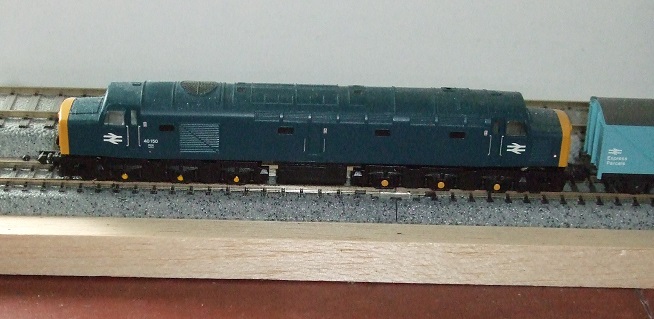
SECOND HAND N GAUGE MODELS #9 -- CLASS 40 BR BLUE LIVERY [No. 40 150]

N Gauge Class 40

Manufacture - Graham Farish [Cat no - 371-178A]
Graham Farish (Poole) Class 40 fitted with later body, numbered 40150, in BR Blue livery with nicely detailed bodywork and all buffers, couplings intact. 

Purchased unboxed it arrived in good condition although it was apparent that the bodywork was slightly loose, suggesting to me that it was perhaps a new body on an older chassis. Wasn't a problem as purchased for a bargain price. 
Began life with us as a slow runner and didn't seem to enjoy the bends of my Kato test track, that's when I notice the body being loose and decided to take it apart for a closer look. Given a good inspection, cleaned and lightly oiled up, was pleased to see it taken back to my test track for an hour of slow but ideal running.

Class 40 - 40150 on bridge
Runs well in both directions, even with a subtle increase of speed all I could do with is a longer track to test how this performs with half a dozen Mk1 coaches behind. Sadly my camera and skills are not the best, but I'm very pleased with the outcome now and has excellent condition throughout, no marks, no damage everything is still intact just the body is still a little loose but no shaking, needs careful handling when picking up that's all.

Head codes
Carries a four box head code block with the numbered end ['Front'] showing - IF 95 while the 'Rear' shows - IF 89.

BR CLASS 40
Locomotives in the range D210–D235 were to be named after ships operated by the companies Cunard Line, Elder Dempster Lines, and Canadian Pacific Steamships, as they hauled express trains to Liverpool, the home port of these companies. The only locomotive not to carry a name was D226 which was to carry the name Media but never did so. From approximately 1970, with Class 40s no longer working these trains, the nameplates were gradually removed. A series of unofficial names were applied to the Class 40s by enthusiasts and enthusiastic depot staff. Some locos ran in service with these names applied for many months, others were painted out within days. 

This included my model which according to my limited research 40150 would have carried the unofficial name of 'Crewe'. Our model would have been withdrawn as part of the final batch in 1985 and scrapped.

N Gauge Class 40

Class 40 Background
The British Rail Class 40 is a type of British railway diesel electric locomotive. A total of 200 were built by English Electric between 1958 and 1962. They were originally numbered D200-D399. They were, for a time, the pride of British Rail’s early diesel fleet. However, despite their initial success, by the time the last examples were entering service they were already being replaced on some top-level duties by more powerful locomotives. As they were slowly relegated from express passenger uses, the type found work on secondary passenger and freight services where they worked for many years. The final locomotives ended regular service in 1985.

Class 40 in Preservation
Seven locomotives and one cab end (40 088) have been preserved on heritage railways, including the first built, number D200, and the Departmental Locomotives, 97 406, 97 407, 97 408.  Of the seven class 40's to be preserved all except for 40118 have run in preservation and three have run on the main line in preservation, these being Nos D200 (40122), D213 (40013) and D345 (40145).

Class 40 in preservation
One of them, No. 40013 Andania (pictured above) was rescued from Vic Berry's Scrapyard in 1987.[36] D212 Aureol was briefly sent to Vic Berry's Scrapyard for asbestos removal before being moved to its new home at the Midland Railway Centre.

The original build D200 is part of the National Collection and displayed at York NRM (pictured below). Only two have Mainline registration D213 (LSL Diesel Fleet) and D345 (40 145) which is one of three owned by the Class 40 Preservation Society.

Class 40 at York D200

Tuesday, 1 June 2021

SECOND HAND N GAUGE MODELS #8 -- D1036 WESTERN EMPEROR [Class 52 BR Green]

N Gauge - D1036 'Western Emperor'
During the latest Covid 'lock down' have been enjoying my hobby of railway modelling and adding to my collection in N Gauge. Also had a chance to give a fair few of my models a test run at home, although the O Gauge stuff will just have to wait till some of the local open days can restart but in this blog we'll going to talk about one of my favourite diesel classes from my childhood, the Westerns. Class 52's that used to thunder across the Western Region of England hauling express passenger services to Bristol, Devon and Cornwall. Having already picked up a couple of different Westerns (and I still really want the sand coloured one to complete the different liveries) I was delighted to pick up a third one in BR Green "Western Emperor". There are a number of Blue westerns on eBay and they are going for a pretty high price so was pleased to pick this up for under £40 and even more so when it didn't take much more than a clean up and oil to have it running nicely on my test track at home. Very smooth immaculate looking locomotives just like the real thing. Some pictures of my model to follow;


Class 52 Background
Built: Crewe Works May 6th 1963, allocated to Old Oak Common (81A)
Livery: On entering service: Green with small-yellow warning panels, black-backed number and nameplates and black roof panels. Was allocated to Laira (84A) depot by the time it was withdrawn from service and subsequently sent to Swindon to be cut up, so sadly this model was scrapped following it's withdrawal from service although at least seven members from this class still survive today.

Royal Duty: On May 10th 1963 Western Emperor is believed to be the 1st Western in use on Royal Train duty when she worked the 1X01 Paddington to Pontypool Road / Abergavenny (+ Abergavenny-Paddington return service).

The D1000 series locomotives were to be named after famous West of England place names; the portfolio shows D1000 bearing the working title "Cheddar Gorge". This trend was not followed in production, however, and the Westerns were named with general heraldic and regimental terms prefixed with the word "Western"

D1036 Western Emperor was built at Crewe in 1962 and withdrawn in 1976.

Class 52 in Preservation
Of the 74 locomotives built, 7 have survived to preservation. While 3 of these are at the Severn Valley Railway it's sad that only 1 is currently available for Main Line running. D1062 Western Courier attended the Rocket 150 celebrations at Rainhill in May 1980, the only privately owned diesel locomotive to do so. Would have been great to see these out in the summer on excursions and trips down to West Country.

D1010 Western Campaigner -- Withdrawn 28.02.77.
Owned by the Diesel & Electric Preservation Group, @West Somerset Railway

D1013 Western Ranger   --   Withdrawn 28.02.77.
Owned by the Western Locomotive Association, @Severn Valley Railway

D1015 Western Champion --  Withdrawn 13.12.76.
Owned by the Diesel Traction Group, @Severn Valley Railway.
It is the only Western Loco that is certified for mainline use.

D1023 Western Fusilier  --   Withdrawn 28.02.77.
The final Western to receive a general overhaul at Swindon works, in February 1973. Now part of the national collection, @National Railway Museum.

D1041 Western Prince --   Withdrawn 23.02.77.
Owned by Diesel Group of the East Lancashire Railway.

D1048 Western Lady -- Withdrawn 28.02.77.
Owned privately, Midland Diesel Group, @Midland Railway – Butterley.

D1062 Western Courier -- Withdrawn 22.08.74.
Owned by Western Locomotive Association, @Severn Valley Railway.

Graham Farish Class 52 [D1036] Western Emperor

Managed to pick this one up via a popular online auction site it's in immaculate condition and a beautiful runner around my own test track. Liked it so much I went back and picked up yet another different Class 52 (Western Gauntlet) as a result I now have one in BR Maroon, Green and Blue livery as a result I am regularly on the look out for the sand livery worn by D1000 Western Enterprise but seems to be very rare and as a result rather expensive. The Green livery does well to break up the regular blues of many of my other BR Diesel's that I currently own, will probably look out for a few steam models next as I think I have more than enough coaching stock for the time being. (rule #1 always applies with my choice of stock).

And here's a picture of the real thing in later BR Blue livery seen ready to depart at Plymouth;

Western Emperor D1036 at Plymouth

Saturday, 30 January 2021

Steam Railtours 2021 - The Winter Cumbrian Mountain Express - Saturday 30th January 2021

Winter Mountain Cumbrian Express

The Winter Cumbrian Mountain Express
Saturday 30th January 2021 - Cancelled due to Covid.

*Update - Sadly having published this in hope at the beginning of 2021, we soon entered another national lockdown and tours including this have been cancelled up to end of February as it stands. We hope that we can get these back up and running soon enough, in the meantime keep safe and well.

Welcome to 2021 and one of the first main line steam hauled train of 2021 starts the year off with a winter scenic day out from the north-west to the Cumbria Fells.  Travelling outwards over the West Coast Main Line via Shap to Carlisle, time will be available to explore this historic border city.  In the afternoon, we head southwards again, but via the highly scenic Settle & Carlisle line.  This will be even more special if there is snow about to enhance the breath taking scenery of the Pennines.  

The train will be hauled by a locomotive from the Carnforth steam pool. This special train will depart from Manchester Victoria at about 07:00 stopping to collect passengers at Bolton and Preston. We enjoy a fast run along the West Coast Main Line (WCML) to Carnforth where we stop for our locomotive to take on water. We climb the first severe gradient up to Grayrigg and then travel through the beautiful Lune Gorge, gaining speed for the ascent to Shap. This well-known section of the WCML has a gradient of 1 in 75 and, in the former days of steam locomotives, banking engines from Tebay were used to assist trains. After crossing the Cumbrian Fells we descend to Penrith, and then head for Carlisle. We stay in the Border City for over two hours, providing ample time to visit the castle, cathedral, museum and shops, or just to relax in one of the many fine coffee shops, restaurants or bars.

We leave Carlisle and begin to climb as soon as we join the Settle & Carlisle Line, one of the best known and best loved stretches of railway line in Britain. We stop at Appleby, for our steam locomotive to take on water. The route then climbs through Kirkby Stephen towards the highest railway summit in England at Ais Gill, 1,169 feet above sea level. We pass over tall viaducts, including the famous one at Ribblehead, and through tunnels. There are magnificent views across the Fells and to the peaks of Pen-y-ghent, Whernside and Ingleborough.

Pen-y-ghent

We should have a fast run out of the hills through to Settle before we stop for our steam locomotive to take on water. We continue through Hellifield and Clitheroe to Blackburn, where we stop to set down passengers. We then head for Bamber Bridge and join the WCML at Farington Junction and make our way towards Bolton, where we stop to set down passengers. Shortly after 19:00, we arrive at our final destination of Manchester Victoria, and the end of a truly marvellous day.

Steam Hauled by one of these available locomotives;

35018 British India Line [SR Merchant Navy Class]


45699 Galatea [LMS Jubilee Class]


46115 Scots Guardsman [LMS Royal Scot Class]


StationOutwardReturn
Manchester Victoria07:0019:08
Bolton07:4518:42
Preston08:1518:40*
Blackburn-------17:54
Carlisle11:3014:15

Wednesday, 16 September 2020

SECOND HAND N GAUGE MODELS #6 -- ANOTHER WARSHIP CLASS 42 D816 "ECLIPSE"


D823 HERMES N GAUGE WARSHIP
Minitrix Class 42 D823 HERMES
Wasn't too long ago I managed to acquire two non working Minitrix Class 42 'Warships' in N Gauge. Now I know that these are reasonably common models and these were also many years old, but as I managed to pick up the pair of them fairly cheaply as non runners with a view to try and get at least one of them going again. Both were in pretty good condition bearing in mind their age, and even if I could only get one of them going again I would be very happy as I could double head them. Although of course I would have to do something with the numbers and names as both are the same and carry the name HERMES would look odd even on my simple test track unless I could get them changed. Well I did manage to get one of these working which made me happy, and have been looking to pick up another of the class with different name, number and / or colour (latter is not important but they are out there).

N Gauge Class 42 D816 Eclipse
Had been on the look out for at least one other in the same class for my collection and in September 2020 I found myself finally taking ownership of another Warship Class but at least with a different number and name this time, we've pickted up D816 ECLIPSE. Boxed Minitrix item and really pleased it's in such great condition too. Everything appears to be in order and no marks or missing items, so the only thing left was to see if it runs. Some oil, some tlc and yes it does! Working lights too in both forward and reverse, so a good purchase and addition to my fairly modest collection, still on the lookout for another sometime in a different livery for variation.
N Gauge Class 42 D816 Eclipse


While I am probably still going to try and get one of the other available models, BR Green livery (D832 Onslaught? D814 Dragon?) and there's also a Maroon colour scheme one (D815 Druid? D829 Magpie?). Onslaught would be my preference as it's currently one of only two preserved locomotives of this class and is running on the East Lancashire Railway. Will be giving this model a good run over the weekend to test it thoroughly then the next stage is to begin work on extending the 'test track'. Hopefully I can continue to create additions to my modest collection and test track at home, would like to make a small diesel depot with my other Westerns, early BR blue models and Mk 1 rolling stock. Pleased with my efforts to get something working again though whatever the quality, some great content on YouTube too helps when you are a novice like myself. Hopefully this experience will help us with the next job at hand as I move into a slightly higher grade, I also have four OO Gauge loco's in need of repair and bringing back into service. On step at a time and small victories are the key...

Sunday, 14 July 2019

SECOND HAND N GAUGE MODELS #4 - CLASS 33 EASTLEIGH (33 021) REPAIRED

N GAUGE MODELS RETURNED TO SERVICE

Recently acquired myself a very nice little set of N Gauge models in the Red Rail-freight livery that you see above with the real version. This set included a Class 33 [33 021 Eastleigh] which was a very popular class of locomotive in my local area on the Southern Region of BR during my trainspotting youth in the 70s and 80s. It was great to pick up one nice and cheaply which also came with a matching wagon set which I've decided to try and add too. Although the locomotive was intact and in great condition it didn't seem to run but that didn't deter me and even with the wagon set only one of these was slightly damaged so for £35 plus postage I think I still got a bargain. 
Graham Farish Class 33 33021 Eastleigh


Though this model did seem to take power initially there was little sign of life in terms of motion, but where there is noise there is hope. Carefully took it all apart, gave it a good clean and applied some oil (I use sewing machine oil seems to do the trick well if applied sparingly, do NOT use stuff like WD40) and within the hour I had her moving. Let it rest a bit and repeated the process at the end of which was gently running around my test track. 
CLASS 33 Eastleigh N Gauge Model
CLASS 33 History
The British Rail Class 33 also known as the BRCW Type 3 or Crompton is a class of Bo-Bo diesel-electric locomotives ordered in 1957 and built for the Southern Region of British Railways between 1960 and 1962. A total of 98 were built by the Birmingham Railway Carriage and Wagon Company (BRCW) and were known as "Cromptons" after the Crompton Parkinson electrical equipment installed in them. Having been designed specifically for the Southern Region, with electric heating apparatus, and some for push/pull operations, in particular, on the Bournemouth to Weymouth line. This avoided the lengthy procedure of uncoupling, running around and coupling. A dozen locomotives, Class 33/2, were built with narrower bodies for traversing the Hastings line. They would see regular service around the Southern Region usually double headed running the Oil Tankers to and from Fawley Refinery in Hampshire and serving the long gone facilities at Staines (west), Earley and North Camp (Farnborough).

Preservation
Most of these locomotives have now been withdrawn from active duty, though three, 33025, 33029 and 33207 are available for use on passenger services with spot hire rail company West Coast Railways. WCRC also has 33030 as a spares donor. A large number of others have been preserved and are operational on heritage railways.
Table of preserved locomotives
1957 numberTOPS numberNameLocationCurrent StatusLivery
D650133002Sea KingSouth Devon RailwayOperationalBR Green
D650833008EastleighShillingstoneUndergoing RestorationBR Green (Yellow Warning Panels)
D651533012Lt Jenny Lewis RNSwanage RailwayOperational and Mainline CertifiedBR Green (Yellow Warning Panels)
D653033018–Midland Railway - ButterleyUndergoing RestorationBR Blue
D653433019GriffonBattlefield Line RailwayOperationalDCE Grey and Yellow
D653933021EastleighChurnet Valley RailwayUndergoing Minor RepairsPost Office Red
D654333025Glen Falloch / SultanCarnforthUnder OverhaulWest Coast Railways
D654733029Glen LoySouthall Railway CentreOperational, Mainline CertifiedWest Coast Railways
D654833030–CarnforthStored (spares loco)Direct Rail Services dark blue
D655333035SpitfireBarrow Hill Engine ShedOperationalBR Blue
D656433046MerlinEast Lancashire RailwayStored (spares Loco)South West Trains blue
D656633048–West Somerset RailwayOperationalBR Green (Yellow Front)
D657033052AshfordKent and East Sussex RailwayStoredBR Green
D657133053–Mid Hants RailwayOperationalBR Blue
D657533057Seagull (Name not Carried)West Somerset RailwayOperationalBR Green (Yellow Front)
D658333063R.J. MitchellSpa Valley RailwayOperationalRailfreight Mainline Sector
D658533065SealionSpa Valley RailwayUndergoing heavy overhaulBR Blue
D651333102SophieChurnet Valley RailwayOperationalBR Blue
D651433103SwordfishEcclesbourne Valley RailwayOperationalBR Blue
D652133108VampireSevern Valley RailwayOperationalBR Blue
D652533109Captain Bill Smith RNREast Lancashire RailwayOperationalBR Blue
D652733110–Bodmin and Wenford RailwayOperationalDepartmental grey
D652833111–Swanage RailwayOperationalBR Blue
D653533116Hertfordshire Rail ToursGreat Central RailwayOperationalBR Blue
D653633117–East Lancashire RailwayUndergoing RepairsBR Blue
D658633201–Spa Valley RailwayOperationalBR Blue (Full Yellow Ends)
D658733202Dennis G. RobinsonMid Hants RailwayOperationalBR Blue
D659233207Jim MartinSouthall Railway CentreOperational, Mainline CertifiedWest Coast Railways
D659333208–Battlefield Line RailwayUndergoing RepairsBR Green (Yellow Warning Panels)
CLASS 33 Rail-freight Colours


Thursday, 22 November 2018

LONDON TO CARDIFF CHRISTMAS MARKET - THURSDAY 22 NOVEMBER


 THE CATHEDRALS EXPRESS 

Thursday 22 November 2018
LNER A4 Class 4-6-2 no 60009 Union of South Africa


LONDON TO CARDIFF CHRISTMAS MARKET

The Cardiff Christmas Market will return to the pedestrian streets of Cardiff City Centre in St John Street, Working Street, Hills Street, Trinity Street and the Hayes in 2018 with an exciting and eclectic mix of both new and returning exhibitors their original, hand made products the essence of what makes this market so different and special.

Visit Cardiff Castle with its Roman walls, Norman keep and stunning medieval halls. Cardiff's city centre provides an vibrant mix of old and new, with beautiful Llandaff Cathedral and the lovely National History Museum alongside the harbour. You can also take in the beauty of Bute Park, Cardiff Castle and many other sights all just a stroll away from the market

LOCOMOTIVE
Originally numbered 4488, 60009 Union of South Africa was built for the LNER in 1937.

It was named after the then newly-formed Union of South Africa, although it had previously been allocated the name "Osprey" on 17 April 1937, when it came out of the paint shop on 29 June. "Osprey" name plates were fitted to the locomotive during the 1980s and early 1990s due to the politics of the time. Its name has since reverted to Union of South Africa. The works number of Union of South Africa was 1853; the plaques are located in the cab itself and not on the exterior cab sides as is the usual practice.

[This trip will be diesel hauled between Newport and Cardiff on the outward journey.]

Train should depart London Paddington approx 09.22 and arrive in Cardiff 13:58. 
The return from Cardiff leaves around 16:40 and gets back into the capital 21:38. 

Should allow for onward connections back home, there are additional stops on route at Reading, Slough and Swindon. 

Monday, 25 June 2018

O GAUGE MODEL -- BR (ex - LNER) CLASS N5 0-6-2 [No. 69307]

LNER N5 No 69307
Gladiator Model Kits sell a 7mm scale (O gauge) kit that builds the N5 or N4 0-6-2T. And I have to presume that it must be one of those as my father made a 
number of different models using Gladiator kits and I have seen at least 2 or 3 different styles of N2, N5, N7 models that he created all having slightly different unqiue fittings included with them. 

Have found some information about this class;

Built 1898, Withdrawn December 1960

Parker introduced the 0-6-2T arrangement to the Manchester Sheffield & Lincolnshire Railway (MS&LR, later GCR) in 1889 as the N4. The basic design proved successful, and in 1891 he revised the design to produce the LNER N5. The MS&LR would classify the N5s as 9F, and used class 9C and 9O for two variants (see below). The revision replaced the original Joy valve gear with Stephenson link motion. He also replaced the round-topped firebox with a Belpaire firebox. In fact, the N5 prototype MS&LR No. 7 was the first locomotive built for a British railway to use the Belpaire design. The neighbouring Beyer Peacock & Co had been using them for a few years, but all of these locomotives were built for export.


Due to the experimental nature of No. 7's firebox, eleven months elapsed before the second locomotive (No. 47) was built. This was followed shortly afterwards by a third, No. 171. This experimental batch of three became class 9C. This length trial period appears to have proved useful because a weakness in the valve gear layout was identified. The valve rods were supported by tubular slide bars fixed to the motion bracket, with the motion bracket positioned in-front of the rocking shaft. All of the production locomotives had a slightly different arrangement and were classified 9F. These had suspension links fixed in-front of the motion plate, supporting the valve rods. The rocking shaft was also behind, and this gave an indirect drive to the valve via a spindle link. This arrangement proved highly successful and was used on virtually all subsequent MS&LR/GCR locomotives and Gresley's J38s and J39s.


O GAUGE MODEL CLASS N5The design was also ordered by Parker's successors, Pollitt and Robinson, resulting in a total of 131 N5s being built between 1891 and 1901. A total of twelve batches including the experimental batch were built.

Four of these locomotives worked with other railways. Nos. 754-5 were sold by the MS&LR to the West Lancashire Railway in 1894 and painted purple. The Lancashire & Yorkshire Railway took over the West Lancashire Railway in 1897 and retired the two 9Fs in 1914. The other two were ordered by the Wrexham Mold & Connah's Quay Railway (WM&CQR) in 1896, and were numbered 17 & 18. The Great Central Railway (GCR) absorbed the WM&CQR in 1905 and renumbered these two engines 409 &. 410 respectively. This brought the GCR's total roster to 129, all of which entered LNER ownership in 1923. It should also be noted that the WM&CQR hired three further 9Fs from the MS&LR/GCR between 1896 and 1901.


O GAUGE MODEL CLASS N5
Class N5/3 No. 9311 at Lincoln in 1948; Larger side tanks, Ross pop safety valves, and footsteps at front
With construction occurring over eleven years and twelve batches, they were built with a number of boiler of variations. 

The main trend was a general reduction in the heating surfaces of the boilers. The last six locomotives were built with what would become LNER Diagram 21. This boiler design was eventually fitted to all of the N5s. This boiler was one of the first that Robinson experimented with superheating, and a total of ten N5s had superheaters fitted between 1915 and 1923. All of the superheaters would eventually be removed. The last was removed in 1943, although No. 5410 was withdrawn in 1936 before its superheater was removed.

The first N5 to be superheated was No. 771 (LNER No. 9311) in November 1915. This was also rebuilt to increase the coal and water capacity. The smokebox was extended to take the new superheater, but the side-tanks were also extended to be inline with the front of the new smokebox. The tanks had openings to allow maintenance of the valve motion. The sides of the coal bunker were raised, and the back was curved at the top. The radial trailing axle was replaced by a pony truck, allowing tighter curves to be negotiated. When the superheater was removed in 1930, the extended bunker, tanks, and smokebox were retained. The GCR classified No. 771 as 9O, and the LNER gave it the sub-class of N5/3 in 1938. It is thought that the modifications were to allow No.771 to haul a shuttle service between Chester and Connah's Quay. However, it only worked this service for fourteen months before being re-allocated and never hauled another passenger service.


O GAUGE MODEL CLASS N5In common with most of the GCR locomotives, the original chimneys were replaced with shorter chimneys and domes to fit within the LNER Composite Loading Gauge. Unmodified locomotives were given the sub-class of N5/1, whilst the modified locomotives became N5/2. These modifications occurred between 1925 and were completed in 1938. The N5/2 designation was eventually dropped.

The N4s and N5s became the GCR's standard shunting and trip working locomotives. After finishing the last N5, the GCR only built specialised shunting locomotives, e.g. for dock and hump shunting. At Grouping, the N5s were distributed amongst twelve sheds, with large allocations at Gorton and Mexborough. Shortly after Grouping (1923), the LNER purchased large numbers of ROD O4 2-8-0s which displaced older J11 0-6-0s onto the Mexborough trip working duties. This dispersed Mexborough's N5 allocation throughout the GC system. The displaced N5s tended to take over J58 and J59 saddletanks which were being withdrawn at the same time.


In the late 1930s, the J11s also displaced many of Gorton's N5s to other duties. Some moved to Trafford Park where they hauled passenger services, and replaced J10s on their shunting duties.


During the 1940s, a number of N5s were allocated to the GN Section. N5s allocated to Bradford hauled passenger trains to Halifax via Queensbury. Copley Hill had an allocation that acted as the Leeds Central station pilot, but also hauled a number of local services during World War 2. Retford and Newark also had allocations for shunting work.

Withdrawal

O GAUGE MODEL CLASS N5

The first withdrawal occurred in 1936, but only eight had been withdrawn by 1945. The remaining 121 locomotives all survived into British Railways ownership (1948). The rapid introduction of diesel shunting locomotives during the 1950s took their toll and withdrawals of the surviving N5s in the late 1950s was rapid. Many were stored during this time. Two of these stored locomotives were moved to Tyne Dock for banking duties, but this appears to have been unsuccessful as they were moved to New England after a few months.

Sheffield (Darnall) had the last large allocation, and these were replaced in 1959 by diesel shunters. Nineteen N5s survived at the beginning of 1960, and all were withdrawn before the end of the year. The last N5 was withdrawn from Gorton in December.


Preservation


The last N5 was withdrawn at the end of 1960, and none of these pioneers of the Belpaire firebox survived into preservation.


O GAUGE MODEL CLASS N5